Artificial intelligence is changing more than the tools attackers use. It is changing the economics of attack.
An adversary can now use AI to explore an application, translate documentation, generate plausible social-engineering messages, mutate payloads, summarize leaked source code, and coordinate repetitive work at a speed that would have required a larger team only a few years ago. The result is not a magical attacker that always wins. It is something more practical—and more important: attackers can test more ideas, adapt sooner, and spend human attention only where it matters most.
Defenders cannot answer that shift with a longer checklist or another static snapshot. The defensive system also has to learn from context, reason across change, and operate at machine speed. In other words, we need to fight AI-enabled threats with AI-enabled defense.
The central idea: AI should not replace security judgment. It should continuously extend the reach of security teams, while authorization, scope controls, and deterministic validation decide what the system is allowed to do—and what the team can trust.
AI changes the economics of cyber threats#
Security programs have always dealt with automation. Scanners crawl routes. Bots test credentials. Malware changes signatures. What is different now is the accessibility of systems that can combine language, code, planning, and feedback.
That combination affects three dimensions of an attack.
Speed#
AI can compress the time between observation and action. A model can read an API description, identify likely authorization boundaries, generate test cases, interpret responses, and propose the next test without waiting for a person to manually connect every step.
Scale#
The same reasoning pattern can be applied across many hosts, repositories, identities, or customer-facing workflows. Even when each individual attempt is imperfect, the cost of trying another variation approaches zero.
Adaptation#
Traditional automation follows a fixed path. AI-enabled workflows can react to what they discover. A failed request, an unexpected schema, or a newly exposed dependency becomes input to the next action.
This is the real asymmetry. A static defense is asked to stop an adaptive process.
Why conventional automation cannot keep pace by itself#
Rules, signatures, and deterministic scanners remain essential. They are fast, explainable, and repeatable. But they work best when the question is already known: Does this request match a signature? Is this package version vulnerable? Did this policy fail?
Modern systems create a different class of questions:
- Does the code imply an ownership check that the running API does not actually enforce?
- Did a connector change the trust boundary around a previously internal service?
- Can several low-severity conditions be combined into a meaningful attack path?
- Is a candidate finding reproducible, or is it a plausible story built from incomplete evidence?
These questions require context and sequencing. They cross repositories, runtime behavior, cloud resources, identities, data flows, and architecture decisions.
| Defensive approach | What it does well | Where it struggles |
|---|---|---|
| Static rules and signatures | Known patterns, policy checks, fast repeatability | Novel combinations and changing context |
| Periodic human review | Deep judgment and business understanding | Continuous coverage and machine-scale change |
| Unbounded autonomous agents | Exploration and adaptation | Safety, consistency, and trustworthy evidence |
| Governed AI plus deterministic validation | Adaptive exploration with controlled proof | Requires strong scope, architecture context, and operational discipline |
The answer is not to discard established controls. It is to give them an adaptive layer that can decide where to look, what to connect, and which hypotheses deserve verification.
AI security needs an adaptive counter-loop#
An effective AI defense behaves less like a one-time scanner and more like a controlled learning loop.
- Observe the system. Ingest architecture, repository context, runtime behavior, identities, dependencies, and recent change.
- Model likely threats. Ask how assets, trust boundaries, and attack paths changed—not only whether a known rule was violated.
- Explore within scope. Use specialized agents to investigate specific hypotheses under explicit authorization and hard boundaries.
- Validate independently. Reproduce candidate findings with deterministic logic that does not depend on the agent believing its own conclusion.
- Update the model. Feed verified evidence and architecture change back into the next defensive cycle.
The loop matters because both sides evolve. An AI-enabled attacker adjusts after every response. A defensive system that only runs quarterly begins each engagement with an outdated understanding of the application.
“AI versus AI” must not mean autonomous chaos#
The phrase fight AI with AI can sound like two unconstrained models battling inside production. That is precisely the wrong operating model.
AI is valuable in security because it can navigate ambiguity. Ambiguity is also why it cannot be the final authority. A production-grade approach needs separate control planes for exploration and truth.
Authorization comes before intelligence#
The system must know who authorized the assessment, which hosts and repositories are included, what techniques are permitted, and when the authorization expires. A model should never infer permission from technical access.
Scope must be enforced more than once#
Scope checks belong at dispatch and again at execution. If an orchestrator makes a mistake, the worker should independently refuse an out-of-scope request. This is defense in depth applied to agentic systems.
Claims need deterministic proof#
Models are good at generating hypotheses. They can also construct confident explanations from weak signals. Candidate findings should therefore travel through a separate verifier that reproduces the behavior, records the request and response, and rejects anything that cannot be demonstrated safely.
Humans still own risk#
Business impact, remediation priority, legal authorization, and exceptions remain human decisions. AI expands coverage; it does not inherit accountability.
A useful boundary: let AI decide what deserves investigation. Let policy decide what is allowed. Let deterministic systems establish what is real. Let people decide what the organization should do next.
Architecture context is the defender’s advantage#
Attackers begin with partial knowledge. Defenders can begin with the architecture—if they can keep that architecture current.
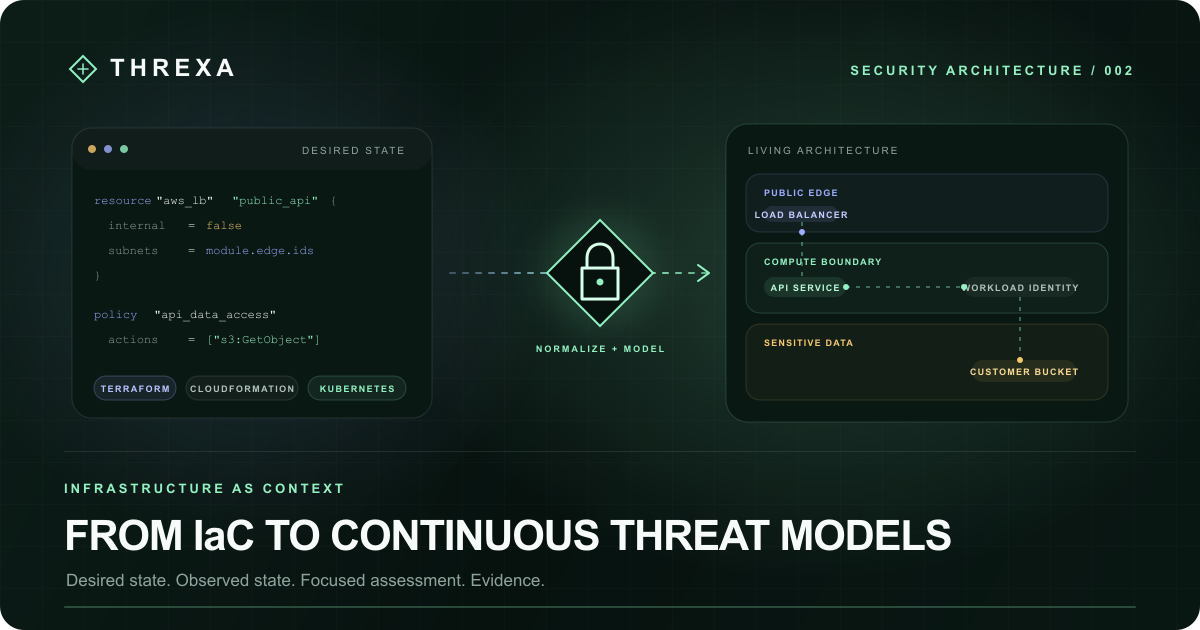
That is a major opportunity. Repository connectors, cloud inventory, identity systems, API catalogs, infrastructure definitions, and architecture diagrams can create a living model of assets and trust boundaries. When a service becomes internet-facing, a data store changes classification, or a new connector receives privileged access, the threat model can change with it.
This makes architecture diagrams operational rather than decorative. A diagram should not be a picture that drifts out of date after a review. It should be a projection of connected system evidence, enriched with security meaning:
- assets and data classifications;
- entry points and identities;
- trust boundaries and privilege transitions;
- dependencies and external connectors;
- candidate attack paths;
- compensating controls and verified findings.
AI is well suited to reconcile these signals because the source material is fragmented and constantly changing. It can propose that a boundary moved or a threat scenario became relevant. The underlying connectors and validation records provide the evidence needed to accept or reject that proposal.
A practical model for fighting AI threats with AI#
Security teams do not need to begin with a fully autonomous platform. They can build the capability in deliberate layers.
1. Establish a trustworthy system map#
Connect the sources that define reality: repositories, deployment configuration, cloud assets, identity providers, API schemas, and architecture records. Assign ownership to critical assets and document the trust boundaries that matter most.
2. Turn threat modeling into a continuous process#
Trigger threat-model updates when the system changes. A new public endpoint, privileged connector, data flow, or identity relationship should prompt targeted questions automatically rather than waiting for the next annual workshop.
3. Give defensive agents narrow missions#
Use one mission per worker: map an endpoint, test an authorization hypothesis, inspect a dependency path, or reconcile a diagram. Narrow missions improve isolation, observability, and the quality of the evidence returned.
4. Separate exploration from verification#
An agent that discovers a possible weakness should not be the mechanism that certifies it. Pass the candidate to fixed, reviewable validation logic. Store enough evidence for another engineer to understand and reproduce the result.
5. Measure outcomes, not agent activity#
The number of prompts, model calls, or generated hypotheses is not a security outcome. Measure whether the system finds meaningful change earlier, reduces false positives, shortens time to proof, and helps teams remediate verified paths.
| Measure | What it reveals |
|---|---|
| Time from architecture change to threat-model update | How quickly defense adapts |
| Candidate-to-verified finding ratio | Signal quality and validation rigor |
| Time to reproducible evidence | Whether findings are operationally useful |
| Percentage of critical assets with current trust boundaries | Quality of architecture context |
| Out-of-scope actions permitted | Control effectiveness—the target is zero |
Where humans remain essential#
AI can compare more signals than a person can hold in working memory, but security is not only a pattern-recognition problem. It is also a question of intent, consequence, and acceptable risk.
People are needed to define the mission, recognize business context, approve intrusive actions, interpret organizational impact, and choose remediation tradeoffs. The strongest operating model pairs machine-speed exploration with human governance and machine-repeatable proof.
This also creates a better role for security engineers. Instead of spending most of their time triaging duplicate alerts and rebuilding stale diagrams, they can focus on system design, difficult attack paths, control quality, and the decisions that require accountability.
The strategic conclusion#
AI will continue to lower the cost of searching for weaknesses. Defenders should assume that exposed behavior, forgotten trust relationships, and small inconsistencies will be tested more frequently and combined more creatively.
The response is not an AI arms race with no rules. It is a better defensive architecture: one that can observe continuously, reason across connected context, adapt its threat model, investigate within strict boundaries, and produce evidence that survives scrutiny.
That is the useful meaning of fighting AI with AI. Adaptive defense meets adaptive attack—but proof, policy, and people remain in control.
Frequently asked questions#
What is AI security?#
AI security includes protecting AI systems from misuse and using AI to strengthen broader cybersecurity. In practice, it covers model and data risks, agent permissions, AI-enabled attacks, and defensive systems that use models to analyze changing technical context.
Can AI replace traditional security tools?#
No. Deterministic scanners, policy engines, access controls, logging, and human review remain foundational. AI is most useful as an adaptive reasoning layer that directs those controls toward the most relevant questions and connects evidence across systems.
Why is deterministic validation important for AI findings?#
Models can produce persuasive but incorrect conclusions. Deterministic validation separates a plausible hypothesis from a reproducible finding by re-running a controlled test and preserving the evidence behind the result.
How does architecture management improve AI threat modeling?#
A current architecture model gives defensive AI reliable context about assets, identities, data flows, dependencies, and trust boundaries. Connectors can keep that model aligned with the real system, allowing threat scenarios to update when the architecture changes.